AI Productivity at Executive Level: Why GVA per Hour Is Not Enough
Most leadership teams agree on one thing: AI is changing productivity in the enterprise.
Far fewer agree on how to measure it.
A common instinct is to use:
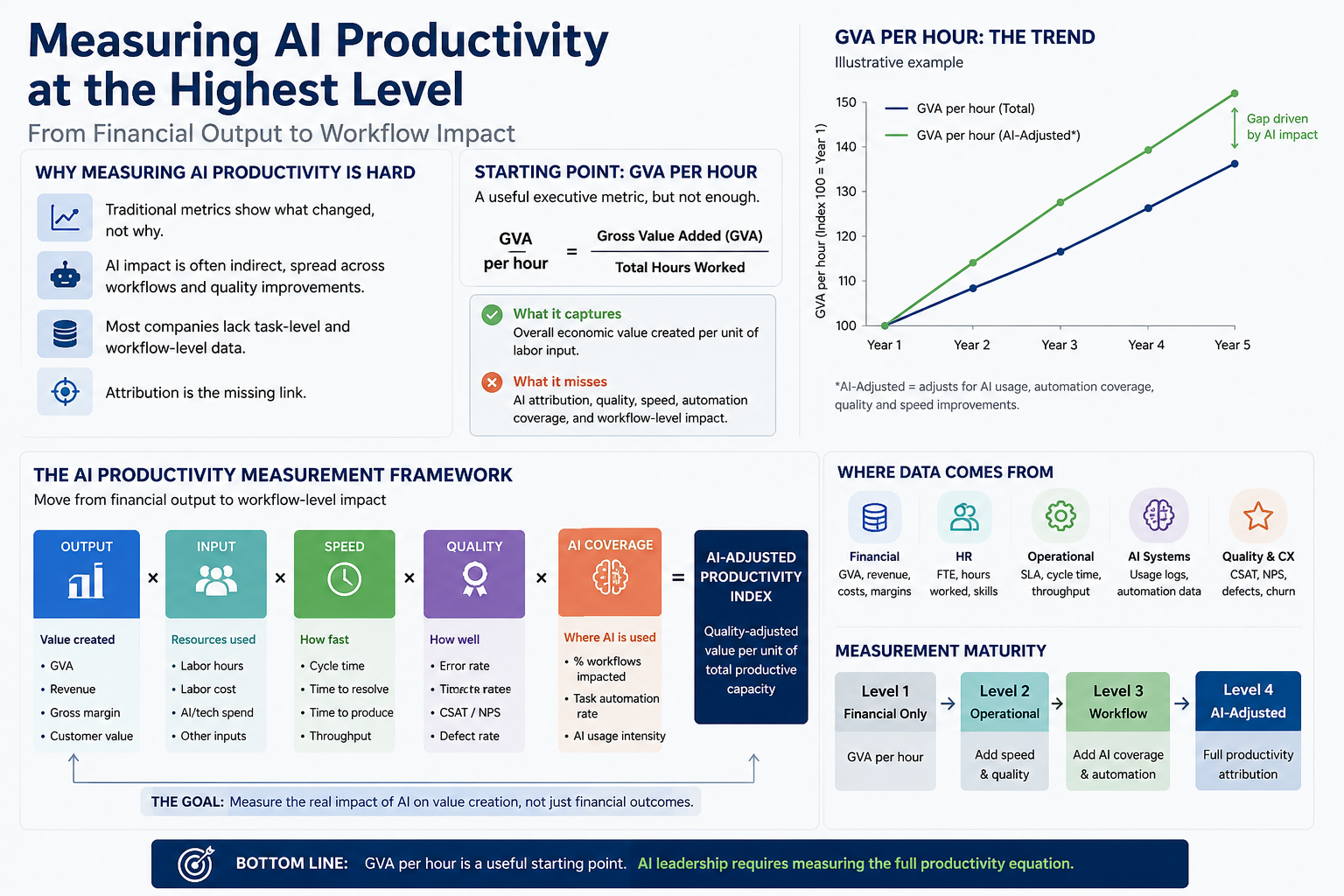
Value added / total hours worked, or more formally:
Gross Value Added (GVA) per hour worked
This is a strong macro-level productivity metric, but it only partially reflects the impact of AI transformation.
1. Why GVA per hour is used in executive reporting
At board level, GVA per hour is attractive because it:
- Aligns with standard economic productivity frameworks
- Normalizes performance across headcount and scale
- Can be derived from financial and HR systems
- Works at company and business-unit level
If AI is improving efficiency, this metric should increase over time.
2. The limitation: it does not isolate AI impact
The key issue is attribution.
GVA per hour cannot distinguish between:
- AI-driven automation gains
- outsourcing or cost restructuring
- pricing or margin expansion
- process optimization unrelated to AI
So it answers:
“Is productivity improving?”
But not:
“Is AI actually driving the improvement?”
This is the core challenge in AI measurement and ROI tracking today.
3. The reality in most organizations
Most companies still lack direct AI productivity measurement.
What they typically have:
- Financial reporting (revenue, margin, GVA)
- HR data (FTE, hours worked)
- Operational KPIs (cycle time, SLAs, throughput)
- Partial IT system usage data
What is usually missing:
- Task-level AI usage tracking
- Workflow-level automation measurement
- Quality-adjusted productivity metrics
- Counterfactual analysis (with vs without AI)
As a result, AI impact is still largely inferred rather than measured.
4. Where AI productivity is measurable today
The clearest visibility is in structured workflows:
IT and software engineering
- Code generation speed
- Deployment frequency
- Incident resolution time
Customer support / shared services
- Tickets per agent
- Average handling time
- Automation rates in chat and email
Finance and back-office operations
- Invoice processing efficiency
- Reconciliation speed
- Document handling automation
These areas are leading in enterprise AI adoption because work is structured and measurable.
5. The direction of travel: workflow productivity
The next evolution in enterprise performance measurement is moving from:
GVA per hour (financial productivity)
to:
workflow-level productivity (operational + AI-driven output)
That requires combining:
- Output (GVA, revenue, margin)
- Input (hours, labor cost, AI cost)
- Speed (cycle time reduction)
- Quality (error rates, rework, customer outcomes)
- AI coverage (where AI is used and how intensively)
6. Bottom line for leadership
GVA per hour remains a useful executive KPI for productivity benchmarking.
But it is not yet a true AI performance metric.
It shows what changed — not what caused the change.
And in most organizations today, that causal layer is still missing.